Projected Gauss Siedel solver.
More...
#include <pinocchio/algorithm/solvers/pgs-solver.hpp>
|
| | PGSConstraintSolverTpl (std::size_t max_problem_size=0) |
| | Default constructor.
|
| bool | isValid () const |
| | Returns true if solver is in a valid state (it has solved a constraint problem). If so, its stats are valid.
|
| void | resetImpl () |
| template<typename DelassusDerived, typename VectorLike, typename ConstraintModel, typename ConstraintModelAllocator, typename ConstraintData, typename ConstraintDataAllocator> |
| bool | solveImpl (DelassusOperatorBase< DelassusDerived > &delassus, const Eigen::MatrixBase< VectorLike > &g, const std::vector< ConstraintModel, ConstraintModelAllocator > &constraint_models, const std::vector< ConstraintData, ConstraintDataAllocator > &constraint_datas, const PGSSolverSettings &settings, PGSSolverResult &result) |
|
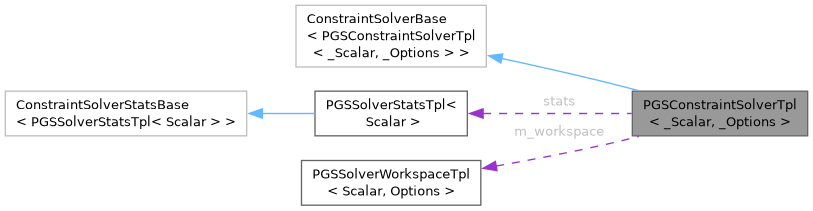
| PGSSolverStats | stats |
| | Per-iteration stats of the PGS solver.
|
|
| static constexpr int | Options = _Options |
|
| bool | m_is_valid |
| | Flag to check whether or not the solver is in a reset state. If not, its stats are valid.
|
| PGSSolverWorkspace | m_workspace |
| | Workspace of the PGS solver. This is an internal of the solver and is not meant to be accessed by users.
|
template<typename _Scalar, int _Options>
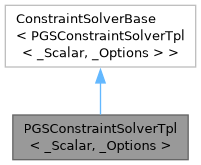
struct pinocchio::PGSConstraintSolverTpl< _Scalar, _Options >
Projected Gauss Siedel solver.
Definition at line 58 of file pgs-solver.hpp.
◆ Base
template<typename _Scalar, int _Options>
| typedef ConstraintSolverBase<Self> Base |
◆ PGSSolverResult
template<typename _Scalar, int _Options>
◆ PGSSolverSettings
template<typename _Scalar, int _Options>
◆ PGSSolverStats
template<typename _Scalar, int _Options>
◆ PGSSolverWorkspace
template<typename _Scalar, int _Options>
| typedef internal::PGSSolverWorkspaceTpl<Scalar, Options> PGSSolverWorkspace |
◆ RefConstVectorXs
template<typename _Scalar, int _Options>
| typedef Eigen::Ref<const VectorXs> RefConstVectorXs |
◆ Scalar
template<typename _Scalar, int _Options>
◆ Self
template<typename _Scalar, int _Options>
◆ VectorXs
template<typename _Scalar, int _Options>
| typedef Eigen::Matrix<Scalar, Eigen::Dynamic, 1, Options> VectorXs |
◆ PGSConstraintSolverTpl()
template<typename _Scalar, int _Options>
| PGSConstraintSolverTpl | ( | std::size_t | max_problem_size = 0 | ) | |
| inlineexplicit |
Default constructor.
- Note
- The user can give max_problem_size to preallocate maximum problem sizes data. This is optional and the solver will automatically resize its workspace to handle the constraint problem thrown at it. If the solver encounters a problem which size is bigger than max_problem_size, it will automatically resize its internals as well as the result output of solve.
- Parameters
| [in] | max_problem_size | maximum problem size (before automatic reallocation) |
Definition at line 84 of file pgs-solver.hpp.
◆ isValid()
template<typename _Scalar, int _Options>
Returns true if solver is in a valid state (it has solved a constraint problem). If so, its stats are valid.
Definition at line 96 of file pgs-solver.hpp.
◆ resetImpl()
template<typename _Scalar, int _Options>
◆ m_is_valid
template<typename _Scalar, int _Options>
Flag to check whether or not the solver is in a reset state. If not, its stats are valid.
Definition at line 134 of file pgs-solver.hpp.
◆ m_workspace
template<typename _Scalar, int _Options>
| PGSSolverWorkspace m_workspace |
| protected |
Workspace of the PGS solver. This is an internal of the solver and is not meant to be accessed by users.
Definition at line 130 of file pgs-solver.hpp.
◆ Options
template<typename _Scalar, int _Options>
◆ stats
template<typename _Scalar, int _Options>
The documentation for this struct was generated from the following files:

 1.17.0