#include <ndcurves/linear_variable.h>
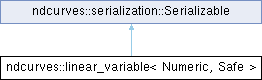
Public Types | |
| typedef Eigen::Matrix< Numeric, Eigen::Dynamic, 1 > | vector_x_t |
| typedef Eigen::Matrix< Numeric, Eigen::Dynamic, Eigen::Dynamic > | matrix_x_t |
| typedef Eigen::Matrix< Numeric, 3, 1 > | vector_3_t |
| typedef Eigen::Matrix< Numeric, 3, 3 > | matrix_3_t |
| typedef linear_variable< Numeric > | linear_variable_t |
Public Member Functions | |
| linear_variable () | |
| linear_variable (const vector_x_t &c) | |
| linear_variable (const matrix_x_t &B, const vector_x_t &c) | |
| linear_variable (const linear_variable_t &other) | |
| ~linear_variable () | |
| vector_x_t | operator() (const Eigen::Ref< const vector_x_t > &val) const |
| Linear evaluation for vector x. | |
| linear_variable_t & | operator+= (const linear_variable_t &w1) |
| Add another linear variable. | |
| linear_variable_t & | operator-= (const linear_variable_t &w1) |
| Substract another linear variable. | |
| linear_variable_t & | operator/= (const double d) |
| Divide by a constant : p_i / d = B_i*x/d + c_i/d. | |
| linear_variable_t & | operator*= (const double d) |
| Multiply by a constant : p_i / d = B_i*x*d + c_i*d. | |
| linear_variable_t | cross (const linear_variable_t &other) const |
| Compute the cross product of the current linear_variable and the other. This method of course only makes sense for dimension 3 curves and dimension 3 unknown, since otherwise the result is non-linear. It assumes that a method point_t cross(const point_t&, const point_t&) has been defined. | |
| std::size_t | size () const |
| Get dimension of linear variable. | |
| Numeric | norm () const |
| Get norm of linear variable (Norm of B plus norm of C). | |
| bool | isApprox (const linear_variable_t &other, const double prec=Eigen::NumTraits< Numeric >::dummy_precision()) const |
| Check if actual linear variable and other are approximately equal given a precision threshold. Only two curves of the same class can be approximately equal,. | |
| virtual bool | operator== (const linear_variable &other) const |
| Check if actual linear variable and other are equal. | |
| virtual bool | operator!= (const linear_variable &other) const |
| Check if actual linear variable and other are different. | |
| const matrix_x_t & | B () const |
| const vector_x_t & | c () const |
| bool | isZero () const |
| template<class Archive> | |
| void | serialize (Archive &ar, const unsigned int version) |
| linear_variable & | operator= (const linear_variable &other) |
| Public Member Functions inherited from ndcurves::serialization::Serializable | |
| template<class Derived> | |
| void | loadFromText (const std::string &filename) |
| Loads a Derived object from a text file. | |
| template<class Derived> | |
| void | saveAsText (const std::string &filename) const |
| Saved a Derived object as a text file. | |
| template<class Derived> | |
| void | loadFromXML (const std::string &filename, const std::string &tag_name) |
| Loads a Derived object from an XML file. | |
| template<class Derived> | |
| void | saveAsXML (const std::string &filename, const std::string &tag_name) const |
| Saved a Derived object as an XML file. | |
| template<class Derived> | |
| void | loadFromBinary (const std::string &filename) |
| Loads a Derived object from an binary file. | |
| template<class Derived> | |
| void | saveAsBinary (const std::string &filename) const |
| Saved a Derived object as an binary file. | |
Static Public Member Functions | |
| static linear_variable_t | Zero (size_t dim=0) |
| Get a linear variable equal to zero. | |
| static linear_variable_t | X (size_t dim=0) |
| Get a linear variable equal to the variable. | |
Friends | |
| class | boost::serialization::access |
Member Typedef Documentation
◆ linear_variable_t
| typedef linear_variable<Numeric> ndcurves::linear_variable< Numeric, Safe >::linear_variable_t |
◆ matrix_3_t
| typedef Eigen::Matrix<Numeric, 3, 3> ndcurves::linear_variable< Numeric, Safe >::matrix_3_t |
◆ matrix_x_t
| typedef Eigen::Matrix<Numeric, Eigen::Dynamic, Eigen::Dynamic> ndcurves::linear_variable< Numeric, Safe >::matrix_x_t |
◆ vector_3_t
| typedef Eigen::Matrix<Numeric, 3, 1> ndcurves::linear_variable< Numeric, Safe >::vector_3_t |
◆ vector_x_t
| typedef Eigen::Matrix<Numeric, Eigen::Dynamic, 1> ndcurves::linear_variable< Numeric, Safe >::vector_x_t |
Constructor & Destructor Documentation
◆ linear_variable() [1/4]
| inline |
◆ linear_variable() [2/4]
| inline |
◆ linear_variable() [3/4]
| inline |
◆ linear_variable() [4/4]
| inline |
◆ ~linear_variable()
| inline |
Member Function Documentation
◆ B()
| inline |
◆ c()
| inline |
◆ cross()
| inline |
Compute the cross product of the current linear_variable and the other. This method of course only makes sense for dimension 3 curves and dimension 3 unknown, since otherwise the result is non-linear. It assumes that a method point_t cross(const point_t&, const point_t&) has been defined.
- Parameters
pOther other polynomial to compute the cross product with.
- Returns
- a new polynomial defining the cross product between this and other
◆ isApprox()
| inline |
Check if actual linear variable and other are approximately equal given a precision threshold. Only two curves of the same class can be approximately equal,.
- Parameters
prec : the precision threshold, default Eigen::NumTraits<Numeric>::dummy_precision()
- Returns
- true if the two linear variables are approximately equal.
◆ isZero()
| inline |
◆ norm()
| inline |
Get norm of linear variable (Norm of B plus norm of C).
- Returns
- Norm of linear variable.
◆ operator!=()
| inlinevirtual |
Check if actual linear variable and other are different.
- Parameters
other : the other linear_variable to check.
- Returns
- true if the two linear_variable are different.
◆ operator()()
| inline |
Linear evaluation for vector x.
- Parameters
val : vector to evaluate the linear variable.
- Returns
- Evaluation of linear variable for vector x.
◆ operator*=()
| inline |
Multiply by a constant : p_i / d = B_i*x*d + c_i*d.
- Parameters
d : constant.
- Returns
- Linear variable after operation.
◆ operator+=()
| inline |
Add another linear variable.
- Parameters
w1 : linear variable to add.
- Returns
- Linear variable after operation.
◆ operator-=()
| inline |
Substract another linear variable.
- Parameters
w1 : linear variable to substract.
- Returns
- Linear variable after operation.
◆ operator/=()
| inline |
Divide by a constant : p_i / d = B_i*x/d + c_i/d.
- Parameters
d : constant.
- Returns
- Linear variable after operation.
◆ operator=()
| inline |
◆ operator==()
| inlinevirtual |
Check if actual linear variable and other are equal.
- Parameters
other : the other linear_variable to check.
- Returns
- true if the two linear_variable are equals.
◆ serialize()
| inline |
◆ size()
| inline |
Get dimension of linear variable.
- Returns
- Dimension of linear variable.
◆ X()
| inlinestatic |
Get a linear variable equal to the variable.
- Parameters
dim : Dimension of linear variable.
- Returns
- Linear variable equal to the variable.
◆ Zero()
| inlinestatic |
Get a linear variable equal to zero.
- Parameters
dim : Dimension of linear variable.
- Returns
- Linear variable equal to zero.
Friends And Related Symbol Documentation
◆ boost::serialization::access
| friend |
The documentation for this struct was generated from the following files:
- include/ndcurves/fwd.h
- include/ndcurves/linear_variable.h