#include <ndcurves/bezier_curve.h>
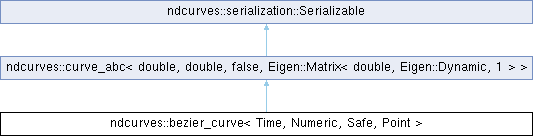
Public Types | |
| typedef Point | point_t |
| typedef Eigen::Matrix< Numeric, Eigen::Dynamic, 1 > | vector_x_t |
| typedef Eigen::Ref< const vector_x_t > | vector_x_ref_t |
| typedef Time | time_t |
| typedef Numeric | num_t |
| typedef curve_constraints< point_t > | curve_constraints_t |
| typedef std::vector< point_t, Eigen::aligned_allocator< point_t > > | t_point_t |
| typedef t_point_t::const_iterator | cit_point_t |
| typedef bezier_curve< Time, Numeric, Safe, Point > | bezier_curve_t |
| typedef std::shared_ptr< bezier_curve_t > | bezier_curve_ptr_t |
| typedef piecewise_curve< Time, Numeric, Safe, point_t, point_t, bezier_curve_t > | piecewise_curve_t |
| typedef curve_abc< Time, Numeric, Safe, point_t > | curve_abc_t |
| typedef curve_abc_t::curve_ptr_t | curve_ptr_t |
| Public Types inherited from ndcurves::curve_abc< Time, Numeric, Safe, Point, Point_derivate > | |
| typedef Point | point_t |
| typedef Point_derivate | point_derivate_t |
| typedef Time | time_t |
| typedef Numeric | num_t |
| typedef curve_abc< Time, Numeric, Safe, point_t, point_derivate_t > | curve_t |
| typedef curve_abc< Time, Numeric, Safe, point_derivate_t > | curve_derivate_t |
| typedef std::shared_ptr< curve_t > | curve_ptr_t |
Public Member Functions | |
| bezier_curve () | |
| Empty constructor. Curve obtained this way can not perform other class functions. | |
| template<typename In> | |
| bezier_curve (In PointsBegin, In PointsEnd, const time_t T_min=0., const time_t T_max=1., const time_t mult_T=1.) | |
| Constructor. Given the first and last point of a control points set, create the bezier curve. | |
| template<typename In> | |
| bezier_curve (In PointsBegin, In PointsEnd, const curve_constraints_t &constraints, const time_t T_min=0., const time_t T_max=1., const time_t mult_T=1.) | |
| Constructor with constraints. This constructor will add 4 points (2 after the first one, 2 before the last one) to ensure that velocity and acceleration constraints are respected. | |
| bezier_curve (const bezier_curve &other) | |
| virtual | ~bezier_curve () |
| Destructor. | |
| virtual point_t | operator() (const time_t t) const |
| Evaluation of the bezier curve at time t. | |
| bool | isApprox (const bezier_curve_t &other, const Numeric prec=Eigen::NumTraits< Numeric >::dummy_precision()) const |
| isApprox check if other and *this are approximately equals. Only two curves of the same class can be approximately equals, for comparison between different type of curves see isEquivalent | |
| virtual bool | isApprox (const curve_abc_t *other, const Numeric prec=Eigen::NumTraits< Numeric >::dummy_precision()) const |
| virtual bool | operator== (const bezier_curve_t &other) const |
| virtual bool | operator!= (const bezier_curve_t &other) const |
| bezier_curve_t | compute_derivate (const std::size_t order) const |
| Compute the derived curve at order N. Computes the derivative order N, \(\frac{d^Nx(t)}{dt^N}\) of bezier curve of parametric equation x(t). | |
| bezier_curve_t * | compute_derivate_ptr (const std::size_t order) const |
| Compute the derived curve at order N. | |
| bezier_curve_t | compute_primitive (const std::size_t order, const point_t &init) const |
| Compute the primitive of the curve at order N. Computes the primitive at order N of bezier curve of parametric equation \(x(t)\). At order \(N=1\), the primitve \(X(t)\) of \(x(t)\) is such as \(\frac{dX(t)}{dt} = x(t)\). | |
| bezier_curve_t | compute_primitive (const std::size_t order) const |
| bezier_curve_t * | compute_primitive_ptr (const std::size_t order, const point_t &init) const |
| bezier_curve_t | elevate (const std::size_t order) const |
| Computes a Bezier curve of order degrees higher than the current curve, but strictly equivalent. Order elevation is required for addition / substraction and other comparison operations. | |
| void | elevate_self (const std::size_t order) |
| Elevate the Bezier curve of order degrees higher than the current curve, but strictly equivalent. Order elevation is required for addition / substraction and other comparison operations. | |
| virtual point_t | derivate (const time_t t, const std::size_t order) const |
| Evaluate the derivative order N of curve at time t. If derivative is to be evaluated several times, it is rather recommended to compute derived curve using compute_derivate. | |
| point_t | evalBernstein (const Numeric t) const |
| Evaluate all Bernstein polynomes for a certain degree. A bezier curve with N control points is represented by : \(x(t) =
\sum_{i=0}^{N} B_i^N(t) P_i\) with \( B_i^N(t) = \binom{N}{i}t^i
(1-t)^{N-i} \). Warning: the horner scheme is about 100 times faster than this method. This method will probably be removed in the future as the computation of bernstein polynomial is very costly. | |
| Public Member Functions inherited from ndcurves::curve_abc< Time, Numeric, Safe, Point, Point_derivate > | |
| curve_abc () | |
| Constructor. | |
| virtual | ~curve_abc () |
| Destructor. | |
| bool | isEquivalent (const curve_t *other, const Numeric prec=Eigen::NumTraits< Numeric >::dummy_precision(), const size_t order=5) const |
| isEquivalent check if other and *this are approximately equal by values, given a precision threshold. This test is done by discretizing both curves and evaluating them and their derivatives. | |
| virtual bool | isApprox (const curve_t *other, const Numeric prec=Eigen::NumTraits< Numeric >::dummy_precision()) const =0 |
| isApprox check if other and *this are approximately equal given a precision threshold Only two curves of the same class can be approximately equal, for comparison between different type of curves see isEquivalent. | |
| virtual std::size_t | dim () const =0 |
| Get dimension of curve. | |
| virtual time_t | min () const =0 |
| Get the minimum time for which the curve is defined. | |
| virtual time_t | max () const =0 |
| Get the maximum time for which the curve is defined. | |
| virtual std::size_t | degree () const =0 |
| Get the degree of the curve. | |
| std::pair< time_t, time_t > | timeRange () |
| template<class Archive> | |
| void | serialize (Archive &ar, const unsigned int version) |
| Public Member Functions inherited from ndcurves::serialization::Serializable | |
| template<class Derived> | |
| void | loadFromText (const std::string &filename) |
| Loads a Derived object from a text file. | |
| template<class Derived> | |
| void | saveAsText (const std::string &filename) const |
| Saved a Derived object as a text file. | |
| template<class Derived> | |
| void | loadFromXML (const std::string &filename, const std::string &tag_name) |
| Loads a Derived object from an XML file. | |
| template<class Derived> | |
| void | saveAsXML (const std::string &filename, const std::string &tag_name) const |
| Saved a Derived object as an XML file. | |
| template<class Derived> | |
| void | loadFromBinary (const std::string &filename) |
| Loads a Derived object from an binary file. | |
| template<class Derived> | |
| void | saveAsBinary (const std::string &filename) const |
| Saved a Derived object as an binary file. | |
Member Typedef Documentation
◆ bezier_curve_ptr_t
| typedef std::shared_ptr<bezier_curve_t> ndcurves::bezier_curve< Time, Numeric, Safe, Point >::bezier_curve_ptr_t |
◆ bezier_curve_t
| typedef bezier_curve<Time, Numeric, Safe, Point> ndcurves::bezier_curve< Time, Numeric, Safe, Point >::bezier_curve_t |
◆ cit_point_t
| typedef t_point_t::const_iterator ndcurves::bezier_curve< Time, Numeric, Safe, Point >::cit_point_t |
◆ curve_abc_t
| typedef curve_abc<Time, Numeric, Safe, point_t> ndcurves::bezier_curve< Time, Numeric, Safe, Point >::curve_abc_t |
◆ curve_constraints_t
| typedef curve_constraints<point_t> ndcurves::bezier_curve< Time, Numeric, Safe, Point >::curve_constraints_t |
◆ curve_ptr_t
| typedef curve_abc_t::curve_ptr_t ndcurves::bezier_curve< Time, Numeric, Safe, Point >::curve_ptr_t |
◆ num_t
| typedef Numeric ndcurves::bezier_curve< Time, Numeric, Safe, Point >::num_t |
◆ piecewise_curve_t
| typedef piecewise_curve<Time, Numeric, Safe, point_t, point_t, bezier_curve_t> ndcurves::bezier_curve< Time, Numeric, Safe, Point >::piecewise_curve_t |
◆ point_t
| typedef Point ndcurves::bezier_curve< Time, Numeric, Safe, Point >::point_t |
◆ t_point_t
| typedef std::vector<point_t, Eigen::aligned_allocator<point_t> > ndcurves::bezier_curve< Time, Numeric, Safe, Point >::t_point_t |
◆ time_t
| typedef Time ndcurves::bezier_curve< Time, Numeric, Safe, Point >::time_t |
◆ vector_x_ref_t
| typedef Eigen::Ref<const vector_x_t> ndcurves::bezier_curve< Time, Numeric, Safe, Point >::vector_x_ref_t |
◆ vector_x_t
| typedef Eigen::Matrix<Numeric, Eigen::Dynamic, 1> ndcurves::bezier_curve< Time, Numeric, Safe, Point >::vector_x_t |
Constructor & Destructor Documentation
◆ bezier_curve() [1/4]
| inline |
Empty constructor. Curve obtained this way can not perform other class functions.
◆ bezier_curve() [2/4]
| inline |
Constructor. Given the first and last point of a control points set, create the bezier curve.
- Parameters
PointsBegin : an iterator pointing to the first element of a control point container. PointsEnd : an iterator pointing to the last element of a control point container. T_min : lower bound of time, curve will be defined for time in [T_min, T_max]. T_max : upper bound of time, curve will be defined for time in [T_min, T_max]. mult_T : ... (default value is 1.0).
◆ bezier_curve() [3/4]
| inline |
Constructor with constraints. This constructor will add 4 points (2 after the first one, 2 before the last one) to ensure that velocity and acceleration constraints are respected.
- Parameters
PointsBegin : an iterator pointing to the first element of a control point container. PointsEnd : an iterator pointing to the last element of a control point container. constraints : constraints applying on start / end velocities and acceleration. T_min : lower bound of time, curve will be defined for time in [T_min, T_max]. T_max : upper bound of time, curve will be defined for time in [T_min, T_max]. mult_T : ... (default value is 1.0).
◆ bezier_curve() [4/4]
| inline |
◆ ~bezier_curve()
| inlinevirtual |
Destructor.
Member Function Documentation
◆ compute_derivate()
| inline |
Compute the derived curve at order N. Computes the derivative order N, \(\frac{d^Nx(t)}{dt^N}\) of bezier curve of parametric equation x(t).
- Parameters
order : order of derivative.
- Returns
- \(\frac{d^Nx(t)}{dt^N}\) derivative order N of the curve.
◆ compute_derivate_ptr()
| inlinevirtual |
Compute the derived curve at order N.
- Parameters
order : order of derivative.
- Returns
- A pointer to \(\frac{d^Nx(t)}{dt^N}\) derivative order N of the curve.
Implements ndcurves::curve_abc< Time, Numeric, Safe, Point, Point_derivate >.
◆ compute_primitive() [1/2]
| inline |
◆ compute_primitive() [2/2]
| inline |
Compute the primitive of the curve at order N. Computes the primitive at order N of bezier curve of parametric equation \(x(t)\).
At order \(N=1\), the primitve \(X(t)\) of \(x(t)\) is such as \(\frac{dX(t)}{dt} = x(t)\).
- Parameters
order : order of the primitive. init : constant valuefor the first point of the primitive (can tipycally be zero)
- Returns
- primitive at order N of x(t).
◆ compute_primitive_ptr()
| inline |
◆ derivate()
| inlinevirtual |
Evaluate the derivative order N of curve at time t. If derivative is to be evaluated several times, it is rather recommended to compute derived curve using compute_derivate.
- Parameters
order : order of derivative. t : time when to evaluate the curve.
- Returns
- \(\frac{d^Nx(t)}{dt^N}\) point corresponding on derived curve of order N at time t.
Implements ndcurves::curve_abc< Time, Numeric, Safe, Point, Point_derivate >.
◆ elevate()
| inline |
Computes a Bezier curve of order degrees higher than the current curve, but strictly equivalent. Order elevation is required for addition / substraction and other comparison operations.
- Parameters
order : number of order the curve must be updated
- Returns
- An equivalent Bezier, with one more degree.
◆ elevate_self()
| inline |
Elevate the Bezier curve of order degrees higher than the current curve, but strictly equivalent. Order elevation is required for addition / substraction and other comparison operations.
- Parameters
order : number of order the curve must be updated
◆ evalBernstein()
| inline |
Evaluate all Bernstein polynomes for a certain degree. A bezier curve with N control points is represented by : \(x(t) =
\sum_{i=0}^{N} B_i^N(t) P_i\) with \( B_i^N(t) = \binom{N}{i}t^i
(1-t)^{N-i} \).
Warning: the horner scheme is about 100 times faster than this method.
This method will probably be removed in the future as the computation of bernstein polynomial is very costly.
- Parameters
t : time when to evaluate the curve.
- Returns
- \(x(t)\) point corresponding on curve at time t.
◆ isApprox() [1/2]
| inline |
isApprox check if other and *this are approximately equals. Only two curves of the same class can be approximately equals, for comparison between different type of curves see isEquivalent
- Parameters
other the other curve to check prec the precision threshold, default Eigen::NumTraits<Numeric>::dummy_precision()
- Returns
- true if the two curves are approximately equals
◆ isApprox() [2/2]
| inlinevirtual |
◆ operator!=()
| inlinevirtual |
◆ operator()()
| inlinevirtual |
Evaluation of the bezier curve at time t.
- Parameters
t : time when to evaluate the curve.
- Returns
- \(x(t)\) point corresponding on curve at time t.
Implements ndcurves::curve_abc< Time, Numeric, Safe, Point, Point_derivate >.
◆ operator==()
| inlinevirtual |
The documentation for this struct was generated from the following file:
- include/ndcurves/bezier_curve.h