#include <hpp/manipulation/path-planner/end-effector-trajectory.hh>
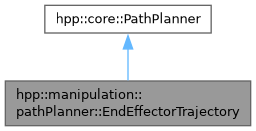
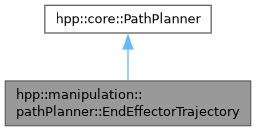
Public Member Functions | |
| virtual void | startSolve () |
| virtual void | oneStep () |
| One step of the algorithm. | |
| int | nRandomConfig () const |
| void | nRandomConfig (int n) |
| int | nDiscreteSteps () const |
| Number of steps to generate goal config (successive projections). | |
| void | nDiscreteSteps (int n) |
| void | checkFeasibilityOnly (bool enable) |
| bool | checkFeasibilityOnly () const |
| void | ikSolverInitialization (IkSolverInitializationPtr_t solver) |
| void | tryConnectInitAndGoals () |
| Public Member Functions inherited from hpp::core::PathPlanner | |
| virtual | ~PathPlanner () |
| virtual const roadmap () const | |
| problem () const | |
| virtual solve () | |
| virtual PathVectorPtr_t &path) | |
| void | interrupt () |
| void | maxIterations (const unsigned long int &n) |
| unsigned long int | maxIterations () const |
| void | timeOut (const double &timeOut) |
| double | timeOut () const |
| void | stopWhenProblemIsSolved (bool enable) |
| computePath () const | |
Static Public Member Functions | |
| static EndEffectorTrajectoryPtr_t | create (const problem) |
| static EndEffectorTrajectoryPtr_t | createWithRoadmap (const roadmap) |
Protected Member Functions | |
| EndEffectorTrajectory (const problem) | |
| EndEffectorTrajectory (const roadmap) | |
| void | init (const EndEffectorTrajectoryWkPtr_t &weak) |
| Store weak pointer to itself. | |
| Protected Member Functions inherited from hpp::core::PathPlanner | |
| problem) | |
| roadmap) | |
| void | init (const PathPlannerWkPtr_t &weak) |
Detailed Description
Plan a path for a robot with constrained trajectory of an end effector
This path planner only works with a steering method of type steeringMethod::EndEffectorTrajectory. The steering method defines the desired end-effector trajectory using a time-varying constraint.
To plan a path between two configurations q_init and q_goal, the configurations must satisfy the constraint at the beginning and at the end of the definition interval respectively.
The interval of definition \([0,T]\) of the output path is defined by the time-varying constraint of the steering method. This interval is uniformly discretized in a number of samples that can be accessed using method nDiscreteSteps .
The path is planned by successively calling method oneStep that performs the following actions.
- A vector of configurations is produced by appending random configurations to
q_init. The number of random configurations can be accessed by methods nRandomConfig . - for each configuration in the vector,
- the initial configuration of the path is computed by projecting the configuration on the constraint,
- the configuration at following samples is computed by projecting the configuration at the previous sample using the time-varying constraint.
- In case of failure
- in projecting a configuration or
- in validating the path for collision, the loop restart with the next random configuration.
Note that continuity is not tested but enforced by projecting the configuration of the previous sample to compute the configuration at a given sample.
The documentation for this class was generated from the following file:
- include/hpp/manipulation/path-planner/end-effector-trajectory.hh