Odyn-based Sequential Quadratic Programming (SQP) solver. More...
#include <odyn-sqp.hpp>
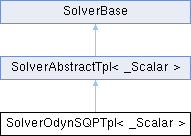
Public Types | |
| typedef ShootingProblem::ActionDataAbstract | ActionDataAbstract |
| typedef ShootingProblem::ActionModelAbstract | ActionModelAbstract |
| typedef CallbackAbstractTpl< Scalar > | CallbackAbstract |
| using | Data = typename odyn::SparseDataTpl<Scalar> |
| typedef MathBaseTpl< Scalar > | MathBase |
| typedef MathBase::MatrixXs | MatrixXs |
| typedef MathBase::MatrixXsRowMajor | MatrixXsRowMajor |
| using | Model = typename odyn::SparseModelTpl<Scalar> |
| using | Params = typename odyn::ParamsTpl<Scalar> |
| typedef ShootingProblemTpl< Scalar > | ShootingProblem |
| using | Solver = typename odyn::SparseQPTpl<Scalar> |
| typedef SolverAbstractTpl< Scalar > | SolverAbstract |
| typedef MathBase::Vector3s | Vector3s |
| typedef MathBase::VectorXs | VectorXs |
| Public Types inherited from SolverAbstractTpl< _Scalar > | |
| typedef ShootingProblem::ActionDataAbstract | ActionDataAbstract |
| typedef ShootingProblem::ActionModelAbstract | ActionModelAbstract |
| typedef CallbackAbstractTpl< Scalar > | CallbackAbstract |
| typedef MathBaseTpl< Scalar > | MathBase |
| typedef ShootingProblemTpl< Scalar > | ShootingProblem |
| typedef MathBase::Vector3s | Vector3s |
| typedef MathBase::VectorXs | VectorXs |
Public Member Functions | |
| SolverOdynSQPTpl (std::shared_ptr< ShootingProblem > problem) | |
| Initialize the OdynSQP solver. | |
| template<typename NewScalar> | |
| SolverOdynSQPTpl< NewScalar > | cast () const |
| Cast the OdynSQP solver to a different scalar type. | |
| virtual bool | checkAcceptance () override |
| Check if we should accept or not the step. | |
| virtual void | computeCandidate (const Scalar step_length=Scalar(1.)) override |
| Compute new candidate solution using step length. | |
| virtual void | computeDirection (const bool recalc=true) override |
Compute the search direction   | |
| Scalar | computeDynamicFeasibility () |
Compute the dynamic feasibility   | |
| Scalar | computeEqualityFeasibility () |
| Compute the feasibility of the equality constraints for the current guess. | |
| virtual void | computeExpectedMeritFunctionImprovement () override |
| Compute the expected merit function improvement for the current step. | |
| Scalar | computeFeasibility (const std::vector< VectorXs > &fs) |
| Compute the feasibility from a given residual vector. | |
| Scalar | computeInequalityFeasibility () |
| Compute the feasibility of the inequality constraints for the current guess. | |
| virtual void | computeMeritFunctionImprovement () override |
| Compute the merit function improvement for the current step. | |
| void | computeQuadraticModel () |
| Build the local Quadratic Program (QP) for the current iterate. | |
| void | decreaseRegularization () override |
| Decrease the state and control regularization values by a regfactor_ factor. | |
| bool | decreaseRegularizationCriteria () override |
| Criteria used to decrease regularization. | |
| virtual Vector3s | expectedImprovement () override |
Return the expected improvement  | |
| void | extractQpDirection (const VectorXs &x) |
| Extract the QP direction into the solver data structures. | |
| std::size_t | get_m () const noexcept |
| Return the number of equality constraints in the SQP. | |
| std::size_t | get_n () const noexcept |
| Return the number of decision variables in the SQP. | |
| std::size_t | get_p () const noexcept |
| Return the number of inequality constraints in the SQP. | |
| Scalar | get_reg_decfactor () const |
| Return the regularization factor used to decrease the damping value. | |
| Scalar | get_reg_incfactor () const |
| Return the regularization factor used to increase the damping value. | |
| Scalar | get_rho () const |
| Return the rho parameter used in the merit function. | |
| Scalar | get_th_acceptminstep () const |
| Return the threshold used for accepting minimum steps. | |
| Scalar | get_th_acceptnegstep () const |
| Return the threshold used for accepting step along ascent direction. | |
| Scalar | get_th_grad () const |
| Return the tolerance of the expected gradient used for testing the step. | |
| Scalar | get_th_minfeas () const |
| Return the threshold for switching to feasibility. | |
| Scalar | get_th_minimprove () const |
| Return the minimum improvement threshold used to increase regularization. | |
| Scalar | get_th_stepdec () const |
| Return the step-length threshold used to decrease regularization. | |
| Scalar | get_th_stepinc () const |
| Return the step-length threshold used to increase regularization. | |
| Scalar | get_upsilon () const |
| Return the estimated penalty parameter that balances relative contribution of the cost function and equality constraints. | |
| Scalar | get_upsilon_decfactor () const |
| Return the upsilon decresing factor used to estimate to balance optimality and feasibility. | |
| odyn::VerboseLevel | get_verbose_level () const noexcept |
| Return the verbose level used in the OdynSQP solver. | |
| bool | get_zero_upsilon () const |
| Return the zero-upsilon label. | |
| void | increaseRegularization () override |
| Increase the state and control regularization values by a regfactor_ factor. | |
| bool | increaseRegularizationCriteria () override |
| Criteria used to increase regularization. | |
| Data & | qp_data () noexcept |
| Return the QP data used in the OdynSQP solver. | |
| Model & | qp_model () noexcept |
| Return the QP model used in the OdynSQP solver. | |
| Params & | qp_params () noexcept |
| Return the QP params used in the OdynSQP solver. | |
| virtual void | resizeData () |
| Resizing the solver data. | |
| void | set_qp_params (const Params ¶ms) |
| Modify the QP params used in the OdynSQP solver. | |
| void | set_reg_decfactor (const Scalar reg_factor) |
| Modify the regularization factor used to decrease the damping value. | |
| void | set_reg_incfactor (const Scalar reg_factor) |
| Modify the regularization factor used to increase the damping value. | |
| void | set_rho (const Scalar rho) |
| Modify the rho parameter used in the merit function. | |
| void | set_th_acceptminstep (const Scalar th_acceptminstep) |
| Modify the threshold used for accepting minimum steps. | |
| void | set_th_acceptnegstep (const Scalar th_acceptnegstep) |
| Modify the threshold used for accepting step along ascent direction. | |
| void | set_th_grad (const Scalar th_grad) |
| Modify the tolerance of the expected gradient used for testing the step. | |
| void | set_th_minfeas (const Scalar th_minfeas) |
| Modify the threshold for switching to feasibility. | |
| void | set_th_minimprove (const Scalar th_step) |
| Modify the minimum improvement threshold used to increase regularization. | |
| void | set_th_noimprovement (const Scalar th_noimprovement) |
| Modify the threshold used to accept steps that cannot be be improved due to numerical errors the th noimprovement object. | |
| void | set_th_stepdec (const Scalar th_step) |
| Modify the step-length threshold used to decrease regularization. | |
| void | set_th_stepinc (const Scalar th_step) |
| Modify the step-length threshold used to increase regularization. | |
| void | set_upsilon_decfactor (const Scalar th_step) |
| Modify the upsilon decresing factor used to estimate to balance optimality and feasibility. | |
| void | set_verbose_level (const odyn::VerboseLevel verbose_level) |
| Modify the verbose level used in the OdynSQP solver. | |
| void | set_zero_upsilon (const bool zero_upsilon) |
| Modify the zero-upsilon label. | |
| virtual Scalar | stoppingCriteria () override |
| Return a positive value that quantifies the algorithm termination. | |
| void | updateCandidate () override |
| Update the candidate solution: cost, feasibilities, and merit value. | |
| virtual void | updateMeritFunction () override |
| Update the merit function value for the current guess. | |
| Public Member Functions inherited from SolverAbstractTpl< _Scalar > | |
| SolverAbstractTpl (std::shared_ptr< ShootingProblem > problem) | |
| Initialize the solver. | |
| virtual void | calcDir () |
| Refresh the linearization of the optimal control problem around the current candidate. | |
| Scalar | computeControlFeasibility (const std::vector< VectorXs > &us) |
| Compute the control box-constraint feasibility from a given control trajectory. | |
| Scalar | computeDynamicFeasibility () |
| Compute the dynamic feasibility | |
| Scalar | computeEqualityFeasibility () |
| Compute the feasibility of the equality constraints for the current guess. | |
| Scalar | computeFeasibility (const std::vector< VectorXs > &fs) |
| Compute the feasibility from a given residual vector. | |
| Scalar | computeInequalityFeasibility () |
| Compute the feasibility of the inequality constraints for the current guess. | |
| Scalar | computeStateFeasibility (const std::vector< VectorXs > &xs) |
| Compute the state box-constraint feasibility from a given state trajectory. | |
| DEPRECATED ("Do not use this threshold. It is not needed by our solvers", Scalar get_th_gaptol() const { return th_gaptol_;}) FeasibilityNorm get_feasnorm() const | |
| Return the threshold for accepting a gap as non-zero. | |
| DEPRECATED ("Do not use this threshold. It is not needed by our solvers", void set_th_gaptol(const Scalar th_gaptol);) void set_feasnorm(const FeasibilityNorm feas_norm) | |
| Modify the threshold for accepting a gap as non-zero. | |
| DEPRECATED ("Use get_preg for primal-variable regularization", Scalar get_xreg() const { return preg_;}) DEPRECATED("Use get_preg for primal-variable regularization" | |
| DEPRECATED ("Use set_preg for primal-variable regularization", void set_xreg(const Scalar xreg) { if(xreg< Scalar(0.)) { throw_pretty("Invalid argument: "<< "xreg value has to be positive.");} xreg_=xreg;preg_=xreg;}) DEPRECATED("Use set_preg for primal-variable regularization" | |
| const std::vector< Scalar > & | get_alphas () const |
| Return the set of step lengths using by the line-search procedure. | |
| Scalar | get_cost () const |
| Return the cost for the current guess. | |
| Scalar | get_dfeas () const |
| Return the reduction in the feasibility. | |
| Scalar | get_dPhi () const |
Return the reduction in the merit function  | |
| Scalar | get_dPhiexp () const |
Return the expected reduction in the merit function  | |
| Scalar | get_dreg () const |
| Return the dual-variable regularization. | |
| const std::vector< VectorXs > & | get_dus () const |
Return the feedforward gains  | |
| const Vector3s & | get_DV () const |
| Return the constant, linear, and quadratic terms of the expected improvement. | |
| Scalar | get_dV () const |
Return the reduction in the cost function  | |
| Scalar | get_dVexp () const |
Return the expected reduction in the cost function  | |
| const std::vector< VectorXs > & | get_dxs () const |
Return the linear update in  | |
| Scalar | get_feas () const |
| Return the total feasibility for the current guess. | |
| Scalar | get_ffeas () const |
| Return the dynamic feasibility for the current guess. | |
| Scalar | get_ffeas_try () const |
| Return the dynamic feasibility for the current step length. | |
| const std::vector< VectorXs > & | get_fs () const |
Return the dynamic infeasibility  | |
| const std::vector< VectorXs > & | get_fs_try () const |
| Return the trail dynamic infeasibility | |
| Scalar | get_gfeas () const |
| Return the inequality feasibility for the current guess. | |
| Scalar | get_gfeas_try () const |
| Return the inequality feasibility for the current step length. | |
| Scalar | get_hfeas () const |
| Return the equality feasibility for the current guess. | |
| Scalar | get_hfeas_try () const |
| Return the equality feasibility for the current step length. | |
| bool | get_is_feasible () const |
Return the feasibility status of the  | |
| std::size_t | get_iter () const |
| Return the number of iterations performed by the solver. | |
| Scalar | get_merit () const |
| Return the merit for the current guess. | |
| Scalar | get_preg () const |
| Return the primal-variable regularization. | |
| const std::shared_ptr< ShootingProblem > & | get_problem () const |
| Return the shooting problem. | |
| Scalar | get_reg_max () const |
| Return the maximum regularization value. | |
| Scalar | get_reg_min () const |
| Return the minimum regularization value. | |
| Scalar | get_steplength () const |
Return the step length  | |
| Scalar | get_stop () const |
| Return the stopping-criteria value computed by stoppingCriteria(). | |
| Scalar | get_th_acceptstep () const |
| Return the threshold used for accepting a step. | |
| Scalar | get_th_stop () const |
| Return the tolerance for stopping the algorithm. | |
| Scalar | get_ureg () const |
| const std::vector< VectorXs > & | get_us () const |
Return the control trajectory  | |
| const std::vector< VectorXs > & | get_us_try () const |
| Return the trial control trajectory | |
| const std::vector< VectorXs > & | get_xs () const |
Return the state trajectory  | |
| const std::vector< VectorXs > & | get_xs_try () const |
| Return the trial state trajectory | |
| const std::vector< std::shared_ptr< CallbackAbstract > > & | getCallbacks () const |
| Return the list of callback functions using for diagnostic. | |
| void | set_alphas (const std::vector< Scalar > &alphas) |
| Modify the set of step lengths using by the line-search procedure. | |
| void | set_dreg (const Scalar dreg) |
| Modify the dual-variable regularization value. | |
| void | set_preg (const Scalar preg) |
| Modify the primal-variable regularization value. | |
| void | set_reg_max (const Scalar regmax) |
| Modify the maximum regularization value. | |
| void | set_reg_min (const Scalar regmin) |
| Modify the minimum regularization value. | |
| void | set_th_acceptstep (const Scalar th_acceptstep) |
| Modify the threshold used for accepting step. | |
| void | set_th_stop (const Scalar th_stop) |
| Modify the tolerance for stopping the algorithm. | |
| void | set_ureg (const Scalar ureg) |
| void | set_us (const std::vector< VectorXs > &us) |
| Modify the control trajectory | |
| void | set_xs (const std::vector< VectorXs > &xs) |
| Modify the state trajectory | |
| void | setCallbacks (const std::vector< std::shared_ptr< CallbackAbstract > > &callbacks) |
| Set a list of callback functions using for the solver diagnostic. | |
| virtual void | setCandidate (const std::vector< VectorXs > &xs_warm=DefaultVector< Scalar >::value, const std::vector< VectorXs > &us_warm=DefaultVector< Scalar >::value, const bool is_feasible=false) |
| Set the solver candidate trajectories | |
| virtual bool | solve (const std::vector< VectorXs > &init_xs=DefaultVector< Scalar >::value, const std::vector< VectorXs > &init_us=DefaultVector< Scalar >::value, const std::size_t maxiter=100, const bool is_feasible=false, const Scalar reg_init=std::numeric_limits< Scalar >::quiet_NaN()) |
Compute the optimal trajectory    | |
| virtual Scalar | tryStep (const Scalar steplength=Scalar(1.)) |
Try a predefined step length   | |
Public Attributes | |
| EIGEN_MAKE_ALIGNED_OPERATOR_NEW typedef _Scalar | Scalar |
| Public Attributes inherited from SolverAbstractTpl< _Scalar > | |
| EIGEN_MAKE_ALIGNED_OPERATOR_NEW typedef _Scalar | Scalar |
Protected Member Functions | |
| void | allocateData () |
| Allocate all the internal data needed for the solver. | |
| virtual void | resizeRunningData () override |
| Resize data associated with the running models of the shooting problem. | |
| virtual void | resizeTerminalData () override |
| Resize data associated with the terminal model of the shooting problem. | |
| void | updateStateAndControlIndex () |
| Protected Member Functions inherited from SolverAbstractTpl< _Scalar > | |
| void | allocateData () |
| Allocate all the basic data needed in solvers. | |
| DEPRECATED ("Do not use this threshold. It is not needed by our solvers", Scalar th_gaptol_;) enum FeasibilityNorm feasnorm_ | |
| DEPRECATED ("Use preg_ for primal-variable regularization", Scalar xreg_;) DEPRECATED("Use dreg_ for primal-variable regularization" | |
Protected Attributes | |
| bool | acceptstep_ |
| std::vector< Scalar > | alphas_ |
| Set of step lengths using by the line-search procedure. | |
| std::vector< std::shared_ptr< CallbackAbstract > > | callbacks_ |
| Callback functions. | |
| Scalar | cost_ |
| Cost for the current guess. | |
| Scalar | cost_try_ |
| Total cost computed by line-search procedure. | |
| Scalar | dfeas_ |
| Reduction in the feasibility. | |
| Scalar | dImpr_ |
| Scalar | dPhi_ |
| Reduction in the merit function computed by tryStep(). | |
| Scalar | dPhiexp_ |
| Scalar | dreg_ |
| Current dual-variable regularization value. | |
| std::vector< VectorXs > | dus_ |
| Linear control direction (size T). | |
| Vector3s | DV_ |
| LQ approximation of the expected improvement. | |
| Scalar | dV_ |
| Reduction in the cost function computed by tryStep(). | |
| Scalar | dVexp_ |
| Scalar | dVexp_full_ |
| std::vector< VectorXs > | dxs_ |
| Linear state direction (size T + 1). | |
| Scalar | feas_ |
| Total feasibility for the current guess. | |
| Scalar | ffeas_ |
| Feasibility of the dynamic constraints for the current guess. | |
| Scalar | ffeas_try_ |
| std::vector< VectorXs > | fs_ |
| Dynamics gaps in each node. | |
| std::vector< VectorXs > | fs_try_ |
| Scalar | gfeas_ |
| Scalar | gfeas_try_ |
| Scalar | hfeas_ |
| Scalar | hfeas_try_ |
| bool | is_feasible_ |
| Label that indicates is the iteration is feasible. | |
| std::size_t | iter_ |
| Number of iteration performed by the solver. | |
| std::vector< VectorXs > | Luu_du_ |
| std::vector< VectorXs > | Lxu_du_ |
| std::vector< VectorXs > | Lxx_dx_ |
| std::size_t | m_ |
| Scalar | merit_ |
| Merit for the current guess. | |
| std::size_t | n_ |
| std::size_t | ng_T_ |
| Dimension of termianl inequality constraints. | |
| std::size_t | nh_T_ |
| Dimension of terminal equality constraints. | |
| std::size_t | p_ |
| Scalar | preg_ |
| Current primal-variable regularization value. | |
| std::shared_ptr< ShootingProblem > | problem_ |
| optimal control problem | |
| Data | qp_data_ |
| Model | qp_model_ |
| Params | qp_params_ |
| Solver | qp_solver_ |
| Scalar | reg_decfactor_ |
| Scalar | reg_incfactor_ |
| Scalar | reg_max_ |
| Maximum allowed regularization value. | |
| Scalar | reg_min_ |
| < Current control regularization values | |
| Scalar | rho_ |
| Scalar | steplength_ |
| Current applied step length. | |
| Scalar | stop_ |
| Value computed by stoppingCriteria(). | |
| Scalar | th_acceptminstep_ |
| Scalar | th_acceptnegstep_ |
| Scalar | th_acceptstep_ |
| Threshold used for accepting step. | |
| Scalar | th_grad_ |
| Scalar | th_minfeas_ |
| Threshold for switching to feasibility. | |
| Scalar | th_minimprove_ |
| Scalar | th_noimprovement_ |
| Scalar | th_stepdec_ |
| Step-length threshold used to decrease regularization. | |
| Scalar | th_stepinc_ |
| Step-length threshold used to increase regularization. | |
| Scalar | th_stop_ |
| Tolerance for stopping the algorithm. | |
| Scalar | upsilon_ |
| Scalar | upsilon_decfactor_ |
| std::vector< VectorXs > | us_ |
| Control trajectory. | |
| std::vector< std::size_t > | us_idx_ |
| std::vector< VectorXs > | us_try_ |
| Control trajectory computed by line-search procedure. | |
| odyn::VerboseLevel | verbose_level_ |
| VectorXs | x_ |
| std::vector< VectorXs > | xs_ |
| State trajectory. | |
| std::vector< std::size_t > | xs_idx_ |
| std::vector< VectorXs > | xs_try_ |
| State trajectory computed by line-search procedure. | |
| bool | zero_upsilon_ |
| Protected Attributes inherited from SolverAbstractTpl< _Scalar > | |
| bool | acceptstep_ |
| std::vector< Scalar > | alphas_ |
| Set of step lengths using by the line-search procedure. | |
| std::vector< std::shared_ptr< CallbackAbstract > > | callbacks_ |
| Callback functions. | |
| Scalar | cost_ |
| Cost for the current guess. | |
| Scalar | cost_try_ |
| Total cost computed by line-search procedure. | |
| Scalar | dfeas_ |
| Reduction in the feasibility. | |
| Scalar | dImpr_ |
| Scalar | dPhi_ |
| Reduction in the merit function computed by tryStep(). | |
| Scalar | dPhiexp_ |
| Scalar | dreg_ |
| Current dual-variable regularization value. | |
| std::vector< VectorXs > | dus_ |
| Linear control direction (size T). | |
| Vector3s | DV_ |
| LQ approximation of the expected improvement. | |
| Scalar | dV_ |
| Reduction in the cost function computed by tryStep(). | |
| Scalar | dVexp_ |
| Scalar | dVexp_full_ |
| std::vector< VectorXs > | dxs_ |
| Linear state direction (size T + 1). | |
| Scalar | feas_ |
| Total feasibility for the current guess. | |
| Scalar | ffeas_ |
| Feasibility of the dynamic constraints for the current guess. | |
| Scalar | ffeas_try_ |
| std::vector< VectorXs > | fs_ |
| Dynamics gaps in each node. | |
| std::vector< VectorXs > | fs_try_ |
| std::vector< VectorXs > | g_adj_ |
| Adjusted inequality bound. | |
| Scalar | gfeas_ |
| Scalar | gfeas_try_ |
| Scalar | hfeas_ |
| Scalar | hfeas_try_ |
| bool | is_feasible_ |
| Label that indicates is the iteration is feasible. | |
| std::size_t | iter_ |
| Number of iteration performed by the solver. | |
| Scalar | merit_ |
| Merit for the current guess. | |
| std::size_t | ng_T_ |
| Dimension of termianl inequality constraints. | |
| std::size_t | nh_T_ |
| Dimension of terminal equality constraints. | |
| Scalar | preg_ |
| Current primal-variable regularization value. | |
| std::shared_ptr< ShootingProblem > | problem_ |
| optimal control problem | |
| bool | recalcdir_ |
| Scalar | reg_max_ |
| Maximum allowed regularization value. | |
| Scalar | reg_min_ |
| < Current control regularization values | |
| Scalar | steplength_ |
| Current applied step length. | |
| Scalar | stop_ |
| Value computed by stoppingCriteria(). | |
| Scalar | th_acceptstep_ |
| Threshold used for accepting step. | |
| Scalar | th_stop_ |
| Tolerance for stopping the algorithm. | |
| Scalar | tmp_feas_ |
| Temporal variables used for computed the feasibility. | |
| std::vector< VectorXs > | u_adj_ |
| Adjusted control bound. | |
| Scalar | ureg_ |
| std::vector< VectorXs > | us_ |
| Control trajectory. | |
| std::vector< VectorXs > | us_try_ |
| Control trajectory computed by line-search procedure. | |
| bool | was_feasible_ |
| std::vector< VectorXs > | x_adj_ |
| Adjusted state bound. | |
| std::vector< VectorXs > | xs_ |
| State trajectory. | |
| std::vector< VectorXs > | xs_try_ |
| State trajectory computed by line-search procedure. | |
Detailed Description
class crocoddyl::SolverOdynSQPTpl< _Scalar >
Odyn-based Sequential Quadratic Programming (SQP) solver.
This solver wraps Odyn’s sparse QP engine to solve Crocoddyl shooting problems with equality and inequality constraints. At each iteration it builds a sparse QP in computeQuadraticModel(), solves it with Odyn, and then maps the QP step back to state/control updates in computeSearchDirection() / tryStep(). The try step supports infeasible iterates (open dynamics gaps) and line-searches them, which improves globalization on hard-constrained problems. The expected improvement calculation also accounts for the dynamics gaps.
See SolverAbstract(), computeSearchDirection(), tryStep(), and expectedImprovement() for the main iteration steps.
Definition at line 38 of file odyn-sqp.hpp.
Member Typedef Documentation
◆ SolverAbstract
| typedef SolverAbstractTpl<Scalar> SolverAbstract |
Definition at line 44 of file odyn-sqp.hpp.
◆ ShootingProblem
| typedef ShootingProblemTpl<Scalar> ShootingProblem |
Definition at line 45 of file odyn-sqp.hpp.
◆ ActionModelAbstract
| typedef ShootingProblem::ActionModelAbstract ActionModelAbstract |
Definition at line 46 of file odyn-sqp.hpp.
◆ ActionDataAbstract
| typedef ShootingProblem::ActionDataAbstract ActionDataAbstract |
Definition at line 47 of file odyn-sqp.hpp.
◆ CallbackAbstract
| typedef CallbackAbstractTpl<Scalar> CallbackAbstract |
Definition at line 48 of file odyn-sqp.hpp.
◆ MathBase
| typedef MathBaseTpl<Scalar> MathBase |
Definition at line 49 of file odyn-sqp.hpp.
◆ VectorXs
| typedef MathBase::VectorXs VectorXs |
Definition at line 50 of file odyn-sqp.hpp.
◆ Vector3s
| typedef MathBase::Vector3s Vector3s |
Definition at line 51 of file odyn-sqp.hpp.
◆ MatrixXs
| typedef MathBase::MatrixXs MatrixXs |
Definition at line 52 of file odyn-sqp.hpp.
◆ MatrixXsRowMajor
| typedef MathBase::MatrixXsRowMajor MatrixXsRowMajor |
Definition at line 53 of file odyn-sqp.hpp.
◆ Solver
| using Solver = typename odyn::SparseQPTpl<Scalar> |
Definition at line 54 of file odyn-sqp.hpp.
◆ Model
| using Model = typename odyn::SparseModelTpl<Scalar> |
Definition at line 55 of file odyn-sqp.hpp.
◆ Data
| using Data = typename odyn::SparseDataTpl<Scalar> |
Definition at line 56 of file odyn-sqp.hpp.
◆ Params
| using Params = typename odyn::ParamsTpl<Scalar> |
Definition at line 57 of file odyn-sqp.hpp.
Constructor & Destructor Documentation
◆ SolverOdynSQPTpl()
| explicit |
Initialize the OdynSQP solver.
- Parameters
[in] problem Shooting problem [in] dyn_solver Type of dynamic solver [in] term_solver Type of terminal solver
Member Function Documentation
◆ computeDirection()
| overridevirtual |
Compute the search direction
Implements SolverAbstractTpl< _Scalar >.
◆ stoppingCriteria()
| overridevirtual |
Return a positive value that quantifies the algorithm termination.
Implements SolverAbstractTpl< _Scalar >.
◆ expectedImprovement()
| overridevirtual |
Return the expected improvement
Implements SolverAbstractTpl< _Scalar >.
◆ computeMeritFunctionImprovement()
| overridevirtual |
Compute the merit function improvement for the current step.
Reimplemented from SolverAbstractTpl< _Scalar >.
◆ computeExpectedMeritFunctionImprovement()
| overridevirtual |
Compute the expected merit function improvement for the current step.
Reimplemented from SolverAbstractTpl< _Scalar >.
◆ updateMeritFunction()
| overridevirtual |
Update the merit function value for the current guess.
Reimplemented from SolverAbstractTpl< _Scalar >.
◆ checkAcceptance()
| overridevirtual |
Check if we should accept or not the step.
- Returns
- True if we should accept the step. False otherwise
Reimplemented from SolverAbstractTpl< _Scalar >.
◆ computeCandidate()
| overridevirtual |
Compute new candidate solution using step length.
Reimplemented from SolverAbstractTpl< _Scalar >.
◆ computeQuadraticModel()
| void computeQuadraticModel | ( | ) |
Build the local Quadratic Program (QP) for the current iterate.
The QP has the form
![\[ \min_{x}\ \tfrac{1}{2}\, x^\top Q\, x \;+\; c^\top x
\quad\text{s.t.}\quad
A\,x = b,\;\; G\,x \le h .
\]](form_298_dark.png)
Here, x is the full decision vector over the trajectory and controls, and Q, c, A, b, G, h are the corresponding (sparse, structured) cost and constraint matrices/vectors induced by the problem’s temporal layout.
Decision vector ordering:
![\[ x = [\, \Delta x_0,\ \Delta u_0,\ \Delta x_1,\ \Delta
u_1,\ \ldots,\ \Delta x_T \,].
\]](form_299_dark.png)
The sparsity pattern reflects time-coupling (dynamics and local costs/constraints).
- Template Parameters
Scalar Scalar type (e.g., float, double).
◆ updateCandidate()
| overridevirtual |
Update the candidate solution: cost, feasibilities, and merit value.
Reimplemented from SolverAbstractTpl< _Scalar >.
◆ decreaseRegularizationCriteria()
| overridevirtual |
Criteria used to decrease regularization.
Reimplemented from SolverAbstractTpl< _Scalar >.
◆ increaseRegularizationCriteria()
| overridevirtual |
Criteria used to increase regularization.
Reimplemented from SolverAbstractTpl< _Scalar >.
◆ increaseRegularization()
| overridevirtual |
Increase the state and control regularization values by a regfactor_ factor.
Reimplemented from SolverAbstractTpl< _Scalar >.
◆ decreaseRegularization()
| overridevirtual |
Decrease the state and control regularization values by a regfactor_ factor.
Reimplemented from SolverAbstractTpl< _Scalar >.
◆ extractQpDirection()
| void extractQpDirection | ( | const VectorXs & | x | ) |
Extract the QP direction into the solver data structures.
- Parameters
[in] x decision vector from the QP solver
◆ cast()
Cast the OdynSQP solver to a different scalar type.
It is useful for operations requiring different precision or scalar types.
- Template Parameters
NewScalar The new scalar type to cast to.
- Returns
- SolverOdynSQPTpl<NewScalar> A OdynSQP solver with the new scalar type.
◆ get_zero_upsilon()
| bool get_zero_upsilon | ( | ) | const |
Return the zero-upsilon label.
True if we set the estimated penalty parameter (upsilon) to zero when solve is called.
◆ set_zero_upsilon()
| void set_zero_upsilon | ( | const bool | zero_upsilon | ) |
Modify the zero-upsilon label.
- Parameters
zero_upsilon True if we set estimated penalty parameter (upsilon) to zero when solve is called.
◆ resizeRunningData()
| overrideprotectedvirtual |
Resize data associated with the running models of the shooting problem.
Reimplemented from SolverAbstractTpl< _Scalar >.
◆ resizeTerminalData()
| overrideprotectedvirtual |
Resize data associated with the terminal model of the shooting problem.
Reimplemented from SolverAbstractTpl< _Scalar >.
◆ computeDynamicFeasibility()
| Scalar computeDynamicFeasibility | ( | ) |
Compute the dynamic feasibility
The feasibility can be computed using different norms (e.g, 


◆ computeEqualityFeasibility()
| Scalar computeEqualityFeasibility | ( | ) |
Compute the feasibility of the equality constraints for the current guess.
The feasibility can be computed using different norms (e.g,
◆ computeFeasibility()
| Scalar computeFeasibility | ( | const std::vector< VectorXs > & | fs | ) |
Compute the feasibility from a given residual vector.
As in the computeDynamicFeasibility, computeInequalityFeasibility or computeEqualityFeasibility, we can compute the feasibility using different norms (e.g,
- Parameters
[in] fs Vector of residual vectors which we wish to compute the feasibility
- Returns
- the residuals' feasibility
◆ computeInequalityFeasibility()
| Scalar computeInequalityFeasibility | ( | ) |
Compute the feasibility of the inequality constraints for the current guess.
The feasibility can be computed using different norms (e.g,
◆ resizeData()
| virtual |
Resizing the solver data.
If the shooting problem has changed after construction, then this function resizes all the data before starting resolve the problem.
Reimplemented from SolverAbstractTpl< _Scalar >.
Member Data Documentation
◆ Scalar
| EIGEN_MAKE_ALIGNED_OPERATOR_NEW typedef _Scalar Scalar |
Definition at line 43 of file odyn-sqp.hpp.
◆ reg_incfactor_
| protected |
Regularization factor used to increase the damping value
Definition at line 397 of file odyn-sqp.hpp.
◆ reg_decfactor_
| protected |
Regularization factor used to decrease the damping value
Definition at line 399 of file odyn-sqp.hpp.
◆ th_grad_
| protected |
Tolerance of the expected gradient used for testing the step
Definition at line 401 of file odyn-sqp.hpp.
◆ th_noimprovement_
| protected |
Threshold used to accept steps that cannot be be improved due to numerical errors
Definition at line 403 of file odyn-sqp.hpp.
◆ th_stepdec_
| protected |
Step-length threshold used to decrease regularization.
Definition at line 406 of file odyn-sqp.hpp.
◆ th_stepinc_
| protected |
Step-length threshold used to increase regularization.
Definition at line 408 of file odyn-sqp.hpp.
◆ th_minimprove_
| protected |
Minimum improvement threshold used in the regularization scheme
Definition at line 409 of file odyn-sqp.hpp.
◆ th_acceptnegstep_
| protected |
Threshold used for accepting step along ascent direction
Definition at line 411 of file odyn-sqp.hpp.
◆ th_acceptminstep_
| protected |
Threshold used for accepting step along with a minimum length
Definition at line 413 of file odyn-sqp.hpp.
◆ rho_
| protected |
Parameter used in the merit function to predict the expected reduction
Definition at line 415 of file odyn-sqp.hpp.
◆ th_minfeas_
| protected |
Threshold for switching to feasibility.
Definition at line 417 of file odyn-sqp.hpp.
◆ upsilon_
| protected |
Estimated penalty parameter that balances relative contribution of the cost function and equality constraints
Definition at line 419 of file odyn-sqp.hpp.
◆ upsilon_decfactor_
| protected |
Estimated penalty parameter factor used to decrease its value
Definition at line 421 of file odyn-sqp.hpp.
◆ zero_upsilon_
| protected |
True if we wish to set estimated penalty parameter (upsilon) to zero when solve is called.
Definition at line 423 of file odyn-sqp.hpp.
◆ n_
| protected |
Definition at line 426 of file odyn-sqp.hpp.
◆ m_
| protected |
Definition at line 427 of file odyn-sqp.hpp.
◆ p_
| protected |
Definition at line 428 of file odyn-sqp.hpp.
◆ x_
| protected |
Definition at line 429 of file odyn-sqp.hpp.
◆ qp_solver_
| protected |
Definition at line 430 of file odyn-sqp.hpp.
◆ qp_model_
| protected |
Definition at line 431 of file odyn-sqp.hpp.
◆ qp_data_
| protected |
Definition at line 432 of file odyn-sqp.hpp.
◆ qp_params_
| protected |
Definition at line 433 of file odyn-sqp.hpp.
◆ verbose_level_
| protected |
Definition at line 434 of file odyn-sqp.hpp.
◆ xs_idx_
| protected |
Definition at line 435 of file odyn-sqp.hpp.
◆ us_idx_
| protected |
Definition at line 436 of file odyn-sqp.hpp.
◆ Lxx_dx_
| protected |
Second-order change of the cost function 
Definition at line 438 of file odyn-sqp.hpp.
◆ Luu_du_
| protected |
Second-order change of the cost function 
Definition at line 441 of file odyn-sqp.hpp.
◆ Lxu_du_
| protected |
Second-order change of the cost function 
Definition at line 444 of file odyn-sqp.hpp.
◆ acceptstep_
| protected |
Definition at line 771 of file solver-base.hpp.
◆ alphas_
| protected |
Set of step lengths using by the line-search procedure.
Definition at line 702 of file solver-base.hpp.
◆ callbacks_
| protected |
Callback functions.
Definition at line 700 of file solver-base.hpp.
◆ cost_
| protected |
Cost for the current guess.
Definition at line 727 of file solver-base.hpp.
◆ cost_try_
| protected |
Total cost computed by line-search procedure.
Definition at line 728 of file solver-base.hpp.
◆ dfeas_
| protected |
Reduction in the feasibility.
Definition at line 741 of file solver-base.hpp.
◆ dImpr_
| protected |
Reduction in the iteration improvement (i.e., maximum between cost and merit values)
Definition at line 711 of file solver-base.hpp.
◆ dPhi_
| protected |
Reduction in the merit function computed by tryStep().
Definition at line 734 of file solver-base.hpp.
◆ dPhiexp_
| protected |
Expected reduction in the merit function for the selected step length
Definition at line 739 of file solver-base.hpp.
◆ dreg_
| protected |
Current dual-variable regularization value.
Definition at line 757 of file solver-base.hpp.
◆ dus_
| protected |
Linear control direction (size T).
Definition at line 723 of file solver-base.hpp.
◆ DV_
| protected |
LQ approximation of the expected improvement.
Definition at line 732 of file solver-base.hpp.
◆ dV_
| protected |
Reduction in the cost function computed by tryStep().
Definition at line 733 of file solver-base.hpp.
◆ dVexp_
| protected |
Expected reduction in the cost function for the selected step length
Definition at line 737 of file solver-base.hpp.
◆ dVexp_full_
| protected |
Expected reduction in the cost function for a full step length
Definition at line 735 of file solver-base.hpp.
◆ dxs_
| protected |
Linear state direction (size T + 1).
Definition at line 722 of file solver-base.hpp.
◆ feas_
| protected |
Total feasibility for the current guess.
Definition at line 742 of file solver-base.hpp.
◆ ffeas_
| protected |
Feasibility of the dynamic constraints for the current guess.
Definition at line 744 of file solver-base.hpp.
◆ ffeas_try_
| protected |
Feasibility of the dynamic constraints evaluated for the current step length
Definition at line 749 of file solver-base.hpp.
◆ fs_
| protected |
Dynamics gaps in each node.
Definition at line 715 of file solver-base.hpp.
◆ fs_try_
| protected |
Dynamics gaps in each node computed by the line-search procedure
Definition at line 720 of file solver-base.hpp.
◆ gfeas_
| protected |
Feasibility of the inequality constraints for the current guess
Definition at line 745 of file solver-base.hpp.
◆ gfeas_try_
| protected |
Feasibility of the inequality constraints evaluated for the current step length
Definition at line 751 of file solver-base.hpp.
◆ hfeas_
| protected |
Feasibility of the equality constraints for the current guess
Definition at line 747 of file solver-base.hpp.
◆ hfeas_try_
| protected |
Feasibility of the equality constraints evaluated for the current step length
Definition at line 753 of file solver-base.hpp.
◆ is_feasible_
| protected |
Label that indicates is the iteration is feasible.
Definition at line 724 of file solver-base.hpp.
◆ iter_
| protected |
Number of iteration performed by the solver.
Definition at line 731 of file solver-base.hpp.
◆ merit_
| protected |
Merit for the current guess.
Definition at line 729 of file solver-base.hpp.
◆ ng_T_
| protected |
Dimension of termianl inequality constraints.
Definition at line 769 of file solver-base.hpp.
◆ nh_T_
| protected |
Dimension of terminal equality constraints.
Definition at line 768 of file solver-base.hpp.
◆ preg_
| protected |
Current primal-variable regularization value.
Definition at line 756 of file solver-base.hpp.
◆ problem_
| protected |
optimal control problem
Definition at line 698 of file solver-base.hpp.
◆ reg_max_
| protected |
Maximum allowed regularization value.
Definition at line 763 of file solver-base.hpp.
◆ reg_min_
| protected |
< Current control regularization values
Minimum allowed regularization value
Definition at line 762 of file solver-base.hpp.
◆ steplength_
| protected |
Current applied step length.
Definition at line 764 of file solver-base.hpp.
◆ stop_
| protected |
Value computed by stoppingCriteria().
Definition at line 730 of file solver-base.hpp.
◆ th_acceptstep_
| protected |
Threshold used for accepting step.
Definition at line 703 of file solver-base.hpp.
◆ th_stop_
| protected |
Tolerance for stopping the algorithm.
Definition at line 704 of file solver-base.hpp.
◆ us_
| protected |
Control trajectory.
Definition at line 714 of file solver-base.hpp.
◆ us_try_
| protected |
Control trajectory computed by line-search procedure.
Definition at line 719 of file solver-base.hpp.
◆ xs_
| protected |
State trajectory.
Definition at line 713 of file solver-base.hpp.
◆ xs_try_
| protected |
State trajectory computed by line-search procedure.
Definition at line 717 of file solver-base.hpp.
The documentation for this class was generated from the following file:
- /build/source/include/crocoddyl/core/solvers/odyn-sqp.hpp